
Rooftop Solar on a Korean Factory: The Permits, in Order
Key summary
Self-consumption solar doesn't require a power generation business license. Permitting for rooftop solar on a factory proceeds in this order: construction plan filing, pre-use inspection, KEPCO grid interconnection, and development permit. Based on the original statutory text, this piece covers the procedures required at each capacity tier, surplus power rules, and cost items that are easy to overlook.
Procurement options · September 2, 2026 · 6 min read
Contents (10)
Once you have made up your mind to put solar on the factory roof, the next question comes straight away. "So what do we do first?" Search for it and you will find procedural guides, but most of them are not the procedure that applies to us.
The bottom line
Solar for self-consumption does not require a power generation business licence. Because it is not a business that earns revenue by selling electricity but equipment we build to use ourselves, it sits on a different legal track. Follow the "power generation business procedure" that appears on public websites and you will go off to obtain a licence that does not exist for you.
What to filter out first
Almost all the solar procedure guides you can find online are written to the power generation business (selling) standard. Self-consumption (using) differs from it right down to the governing statute.
| Power generation business | Self-consumption | |
|---|---|---|
| Purpose | Revenue from selling electricity | Use at our own factory |
| Power generation business licence | Required | Not required |
| Governing statute | Electric Utility Act | Electrical Safety Management Act |
The construction plan report and the pre-use inspection for private electrical installations moved to the Electrical Safety Management Act in April 2021. Yet there are still public agency guidance pages that cite the old provisions (Articles 61 and 63 of the Electric Utility Act) as their basis. Bear that in mind when you check the provisions.
The full sequence
Roadmap · Self-consumption solar on a factory roof — the broad flow
Preliminary review
Roof structure, spare grid capacity, self-consumption pattern
Local government permits, including the development activity permit
The competent city, county, or district
Grid connection application to KEPCO
Fixing the connection type
Construction plan report
Before starting work · Korea Electrical Safety Corporation
Construction
Appointment of an electrical safety manager
Before applying for the pre-use inspection
Pre-use inspection
Apply 7 days before the date you want
Start of parallel operation
Signing the KEPCO contract
- 1
1
Preliminary review
Roof structure, spare grid capacity, self-consumption pattern
- 2
2
Local government permits, including the development activity permit
The competent city, county, or district
- 3
3
Grid connection application to KEPCO
Fixing the connection type
- 4
4
Construction plan report
Before starting work · Korea Electrical Safety Corporation
- 5
5
Construction
- 6
6
Appointment of an electrical safety manager
Before applying for the pre-use inspection
- 7
7
Pre-use inspection
Apply 7 days before the date you want
- 8
8
Start of parallel operation
Signing the KEPCO contract
What matters in practice within this sequence is the relationship between steps 3 and 4. The outcome of the grid connection consultation changes the capacity of the installation and the connection method, and that feeds into the contents of the construction plan report. Put the grid consultation off until later and you will end up redoing the design.
Which bracket is our installation in
The procedures that attach to a project split according to capacity. The following is based on the text of the statutes.
| Threshold | What it decides | Basis |
|---|---|---|
| Under 10,000 kW | Construction plan report | Enforcement Rule of the Electrical Safety Management Act, Appendix 1 |
| 10,000 kW or more | Construction plan approval | The same Appendix 1 |
| 20 kW or less | Exemption from appointing an electrical safety manager | Enforcement Rule, Article 25(1) |
| Under 1,000 kW (under 3,000 kW with remote monitoring and control) | Safety management may be outsourced | Enforcement Rule, Article 26 |
| Height over 5 m | Structure construction report for a structure | Enforcement Decree of the Building Act, Article 118(1)11 |
Factory rooftop solar is usually somewhere between several hundred kW and a few MW. In other words, most projects fall into the "construction plan report + mandatory pre-use inspection + safety management may be outsourced" bracket. Cases that fall under the approval requirement (10,000 kW or more) are rare.
Height is generally not an issue. In a 2024 interpretation, the Ministry of Government Legislation stated that solar installations of 5 m or less are not subject to the structure construction report (statutory interpretation 24-0644). Even when installed on a roof, it is the height of the structure itself that counts.
Being on a roof does not mean there are no permits
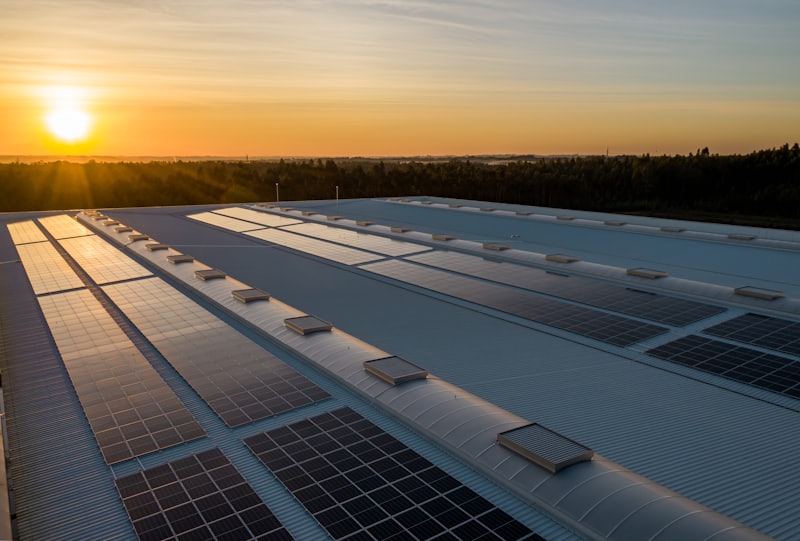
This is the most common misunderstanding. People assume "it is just being laid on top of a building, so what permit could it need", but the Ministry of Land, Infrastructure and Transport has replied that a structure installed on the roof of an existing building is also subject to the development activity permit, apart from minor works.
The threshold for minor works is a horizontal projected area of 50 ㎡ or less in urban areas and district unit planning zones. Factory rooftop solar goes well beyond that threshold.
Practice varies widely between local governments
In practice, there are local governments that treat rooftop systems as building equipment and do not require a development activity permit. The Ministry of Land's reply says they are "subject" to it, but the operation of it differs. Before starting, check with the building and urban planning departments of the competent city, county, or district on the basis of your own site. There are cases where this is skipped, the contractor's word is taken instead, and the work is then halted.
Since it is being laid on a roof, you also need to look at the structural review. Solar installed on a building is treated as ancillary building equipment, and guidance is that it should undergo a structural safety review for vertical load, snow load, and wind load (based on reporting by the Korea Institute of Registered Architects). The older the factory roof, the more likely it is to be caught at this stage.
KEPCO grid connection — set your schedule here
Grid connection is the one stage where a supplier cannot fix its own schedule.
The processing time is not set by law, and it varies with the competent branch and the spare capacity situation on the grid concerned. Where there is spare capacity it is quick; where reinforcement is needed it takes longer. As far as we have been able to confirm, there is no published standard number of processing days.
So in practice, do it this way.
What to do on grid connection
- Ask the competent KEPCO branch for a preliminary consultation before finalising the design
- Ask first about the spare capacity on your site's part of the grid and the expected time required
- Decide the connection type (self-consumption only, or exporting surplus power) at the same time
- Check whether the completion date in the contractor's quotation reflects that answer
Surplus power — check the rule that changed
You can send the power left over after self-consumption to KEPCO. There is a figure that is often quoted here, and it differs from the rule now in force.
The Enforcement Decree of the Electric Utility Act provides that in the case of solar installations, the power left over after your own use may be traded, and sets no percentage limit. The limit of less than 30 per cent of total output attaches only to installations that are not solar.
If you have seen guidance saying "less than 50 per cent", that is the pre-revision standard. It still remains on public agency pages, so when you review your contract terms, check the text of the Enforcement Decree.
If RE100 is the goal, you do not have to go as far as RECs
Many companies look at solar in order to respond to a buyer's renewable energy requirements. Some ask whether they then have to go through the REC issuance procedure as well, and Korea's own RE100 scheme (K-RE100) recognises "self-consumption" as an independent compliance option.
Installing renewable energy equipment you own and using it directly is itself a compliance record. REC issuance is a separate track, and if you need it, you have to apply for equipment verification within one month of completing the pre-use inspection.
What is easy to leave out of the cost
There is an item that normally does not appear in a construction quotation: the pre-use inspection fee.
| Category | Base fee | Per kW |
|---|---|---|
| Extra-high-voltage connection, up to 500 kW | KRW 239,600 | KRW 426 |
| Extra-high-voltage connection, over 500 kW | KRW 351,900 | KRW 349 |
These are the Korea Electrical Safety Corporation's 2026 fees for the pre-use inspection of private installations, and VAT is extra. On top of this, the cost of appointing an electrical safety manager or of an outsourcing contract arises throughout the operating life of the installation.
What you cannot leave to the contractor
The electrical safety manager is the owner's responsibility
The contractor can handle preparing the construction plan report and applying for the pre-use inspection on your behalf. But appointing the electrical safety manager can only be done by the owner or occupier of the installation, or by someone they have entrusted with it. Even if the contractor says they "take care of everything", this item stays in our name.
Set out in the contract who does the appointing and when the outsourcing contract is signed. A certificate of the appointment filing is needed when applying for the pre-use inspection, and there are cases where failing to prepare it pushes the inspection date back.
What to check before you start
Pre-start checklist
- Is our expected capacity under 10,000 kW (it almost certainly is → the report applies)
- Have we checked with the competent city, county, or district whether a development activity permit is needed for a rooftop system
- Who carries out the roof structural safety review, and when
- Have we asked the KEPCO branch about spare grid capacity and the expected time required
- Has it been decided who appoints the electrical safety manager or signs the outsourcing contract
- Does the quotation include the pre-use inspection fee and the safety management cost
- [Source: Enforcement Rule of the Electrical Safety Management Act, Appendix 1 — projects subject to construction plan approval or report]
- [Source: Enforcement Decree of the Electric Utility Act, Article 19 — power trading for private installations]
- [Source: Ministry of Government Legislation, statutory interpretation 24-0644 — scope of the structure construction report for solar, 2024-10-21]
- [Source: Korea Electrical Safety Corporation — 2026 pre-use inspection fees for private installations, 2026]
- [Source: Korea Energy Agency — guidance on K-RE100 compliance options]
Note: The capacity thresholds and fees follow the source texts above. The operation of the development activity permit and the time required for grid connection vary with the local government and the KEPCO branch, so be sure to check in advance. This article is general procedural guidance and is not permit advice for any individual site.

OpenEnergy Editorial Team
Procurement options
We help you choose the right renewable energy procurement route — green premium, REC, PPA, on-site generation — for your company.
More on Procurement options →Talk to an expert about your company's K-RE100 transition
Tell us about your situation and someone here will write back with the right transition route.
We use these details only to answer this enquiry.
Related articles
Related resources
All resources →- Source⭐ FeaturedDocument in Korean
RE100 Handbook for Korean Companies
Korea Energy Agency · Korea Chamber of Commerce and Industry (Corporate Renewable Energy Support Center) · Public institution · Source 2024.07
Korea Energy Agency · Korea Chamber of Commerce and Industry (Corporate Renewable Energy Support Center)
Public institution
Source
2024.07
- Source⭐ FeaturedDocument in Korean
Company Registration Manual for the Renewable Energy Use Certificate
Korea Energy Agency · Public institution · 2026.07
Korea Energy Agency
Public institution
2026.07
- SourceDocument in Korean
Guide to Renewable Energy Matching Products in Korea
Corporate Renewable Energy Support Center (commissioned by Korea Energy Agency, operated by KCCI) · Public institution · Source 2025.01
Corporate Renewable Energy Support Center (commissioned by Korea Energy Agency, operated by KCCI)
Public institution
Source
2025.01
- SourceDocument in Korean
Corporate Renewable Energy Procurement Guidelines
Corporate Renewable Energy Initiative (CoREi) · Industry association · Source 2024.01
Corporate Renewable Energy Initiative (CoREi)
Industry association
Source
2024.01
Stop hunting for REC, PPA and tariff prices
We send REC, SMP, carbon allowance and green premium prices, plus the Korean energy policy changes companies need to track.